
Reduce software risks
Identify critical areas and silent failures before they reach the field or the release.
The start of the chain
In industrial and embedded systems, risk is invisible: it surfaces in production, in an audit, or too late. Software Quality Intelligence™ turns that blind spot into an objective reading — so you decide on facts, not hunches.
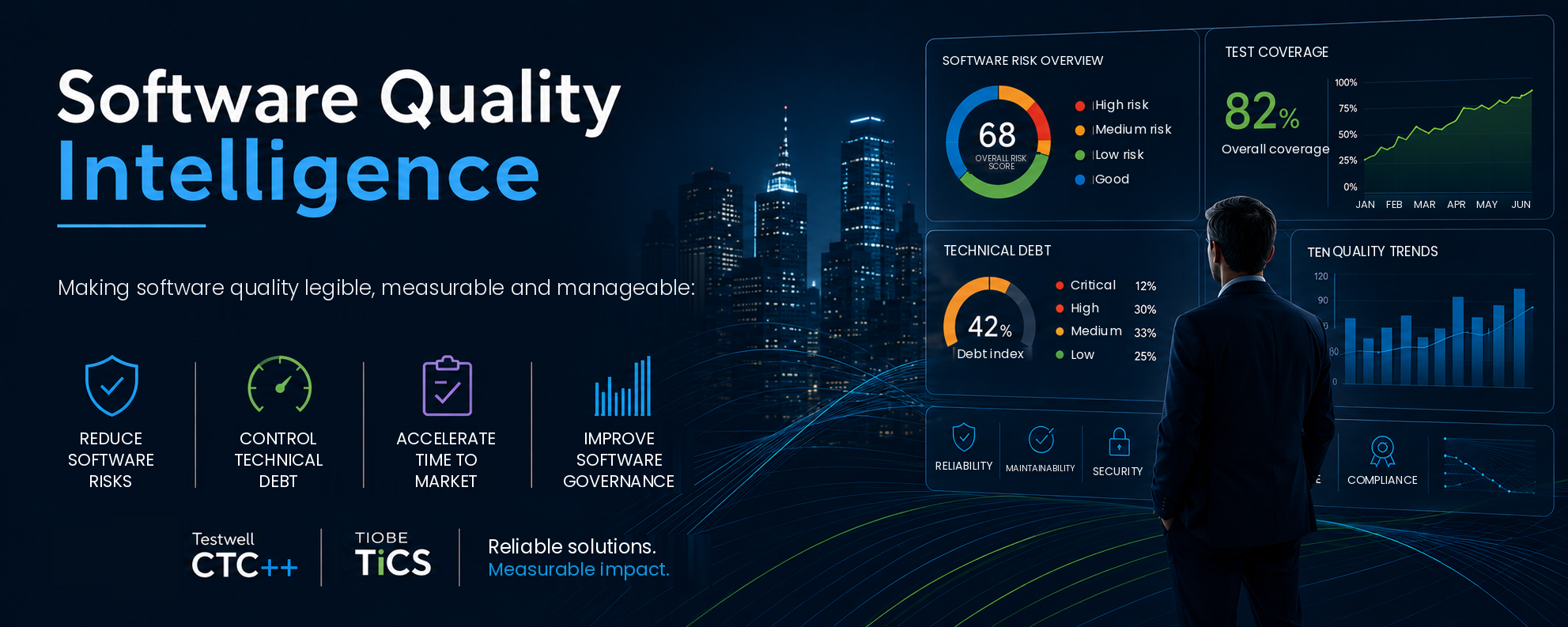
An emergency fix the day before a release. A non-conformity found in an audit. Technical debt that slows every release without anyone really knowing where it hides. These are not isolated incidents: they are the symptoms of quality that goes unmeasured.
A structured approach to reasoning about code quality rather than enduring it, inspired by the TMMi® 2.0 maturity model. The principle is a single chain: by reducing software risks, you control technical debt — and controlled debt accelerates both compliance and deliveries.
Caught upstream, before they reach the release.
Quantified and prioritized — no longer piling up in the shadows.
Audits and certifications approached as a given.
Reliable, predictable releases, without growing the team.
They are not parallel equals: they follow on from one another. Reducing software risks enables control of technical debt, which in turn accelerates compliance and deliveries.
Identify critical areas and silent failures before they reach the field or the release.
Make debt visible, quantify it and prioritize it to focus effort on the 20% of code that carries 80% of the risk.
Healthier code aligns more easily with regulatory requirements: audits and certifications approached without last-minute upheaval.
Healthier code is quicker to change. Less rework, more predictable releases, without hiring more people.
The method is a diagnostic: we start from your context, dig into it, and draw out concrete measures to put in place.
A short pre-qualification questionnaire, sent beforehand, to frame your context in about ten questions. See how it works.
After analyzing your answers, a conversation that digs into each point — how, who decides, what impact — until the gray areas surface.
Findings become measures to put in place: process recommendations and, where the diagnostic warrants it, tooling.
When a software failure means a product recall, a line stoppage or a risk to people, quality stops being a comfort. It becomes a responsibility.
Trajectory, collaborative safety, robustness of critical modules.
Embedded controllers, functional safety, quality before release.
Connected devices, verified safety requirements, compliance.
Critical software, safety requirements, mastering complexity.
Functional safety, SIL levels, criticality by scope.
Autonomous vehicles, engine management, field reliability.
Free and with no commitment. 30 minutes to turn your quality findings — risks, debt, compliance, visibility — into measures you can put in place.