Bit to board.
Not one more analyzer: the layer that makes them all speak with one voice. TiCS orchestrates the static analyzers you already use, maps their results to a single quality model based on ISO/IEC 25010, and makes quality legible and comparable — from the developer's desk to the executive committee. On-premise when your context requires it: your code never leaves.
TiCS isn't a starting point but an answer: it comes in when the diagnostic reveals a need for continuous code quality analysis. The tool serves the identified measure; it doesn't precede it.
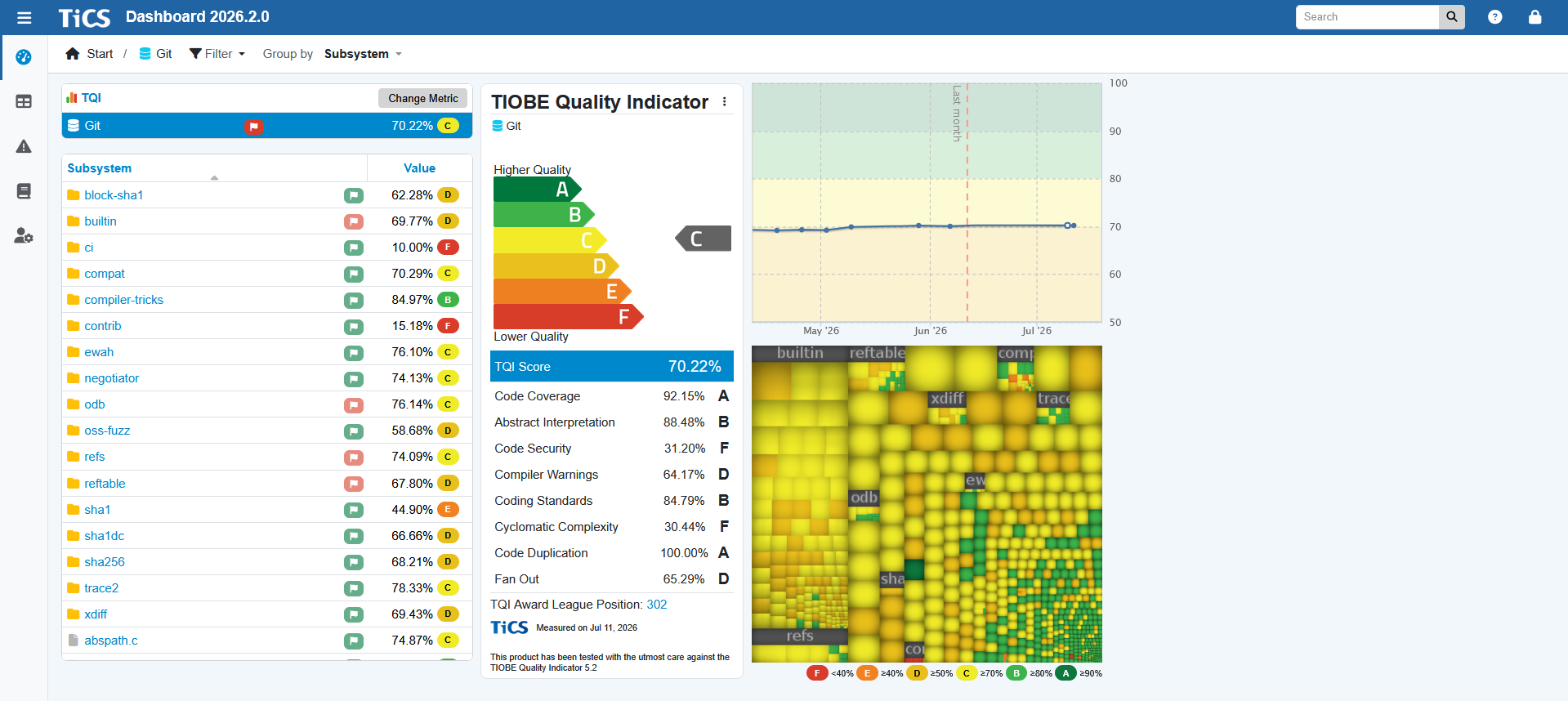
An overview of all your projects — including those developed at different sites around the world — graded from A to F and benchmarked against more than 8,000 industrial projects. You spot trends and drill down to the line of code in a few clicks.
Most quality tools want to become your analyzer. TiCS does the opposite: it aggregates the results of a broad set of static analyzers — including yours — and maps them to a single quality model, so projects stay comparable even when they rely on different tools.
Coverity, Clang-Tidy, Cppcheck, BlackDuck, Mend… TiCS doesn't compete with them: it drives them, and TIOBE maintains them. Nothing to replace, one less burden for your teams.
Everything maps to ISO/IEC 25010, from reliability to maintainability. Two projects, two languages, two toolchains: the score stays comparable.
Your score is benchmarked against more than 8,000 industrial projects. You don't just know where you stand — you know where you rank.
TiCS integrates into your CI/CD pipeline and your IDEs, with quality gates that stop in CI what needs stopping. And it all runs on-premise: analysis happens on your side, without uploading a single line of code — often a decisive point in defense, nuclear, and constrained embedded systems. For less sensitive domains, a SaaS mode is also available.
Every level of the organization has its own questions. TiCS answers them from the same data — not three tools, not three truths that diverge at the first trade-off.
IDE plug-ins give immediate feedback on code quality — even before the commit.
You see which projects need attention and how quality evolves over time.
An enterprise dashboard tracks the entire development portfolio.
At the development level, feedback is immediate: code checks before the commit, quality gates that stop defects, and for each deviation — what, why, and how to do better. At the management level, the dashboard shows which projects are progressing, where the major risks are, and which systems reach an acceptable level of quality.
This is where many tools get switched off after three months: a coding rule isn't always absolute. A line-length limit set at 100 can tolerate 105 if readability improves. TiCS provides two levers to stay practical.
Severity levels focus attention on the rules that matter most. And targeted suppressions allow a deviation at a specific spot, for a good reason — with a clear overview of all the exceptions.
TiCS doesn't measure coverage itself: it collects it from your tools — Testwell CTC++, VectorCAST, Jacoco… — and tracks it continuously, alongside the other metrics. Enough to verify that Test Driven Development holds throughout the project, not just at the start.
Runnable from the IDE before checking in code, it filters out critical standard violations — concrete support for more effective pair programming, focused on the real impact of the code.
Paul Jansen, CEO of TIOBE, walks through the TiCS dashboard: navigating between projects, trends, and drilling down to annotated code.
A project of your choice is analyzed with the TiCS framework, free and fully on-prem: not a line of source code to upload, nothing to leave your network.
After the analysis, you get a dashboard detailing all the results, and the Quality Engineers walk you through their findings. It's on this factual basis that you decide whether TiCS brings value to your organization.
An overview — the full list of languages and ready-to-use integrations is on the TiCS data sheet.
See also the regulatory coverage and the TiCS data sheet ↗.
The simplest way is to start from your context: together we look at whether continuous quality analysis serves your goal — and, if so, the proof of concept will confirm it on your own code.