
Infrastructure inspection, delivery, agriculture, security, defence: drones fly further and further, beyond their pilot's line of sight, over populated areas. Their flight software then decides on its own. The riskier the operation, the more European regulations require proof that this software was developed and verified rigorously.
A drone has no pilot on board to catch an error. Degraded situations are the ones that matter.
The link with the remote pilot is lost: the drone must apply the right procedure, return, hold or land.
A jammed or lost GNSS signal, an inconsistent sensor: navigation must detect it and recover.
Geo-awareness must warn of an approaching restricted zone, and geofencing, where present, must prevent entering it, even on an erroneous command.
A battery draining faster than expected: the endurance calculation decides whether the drone returns in time.
Flight termination must work when everything else has failed.
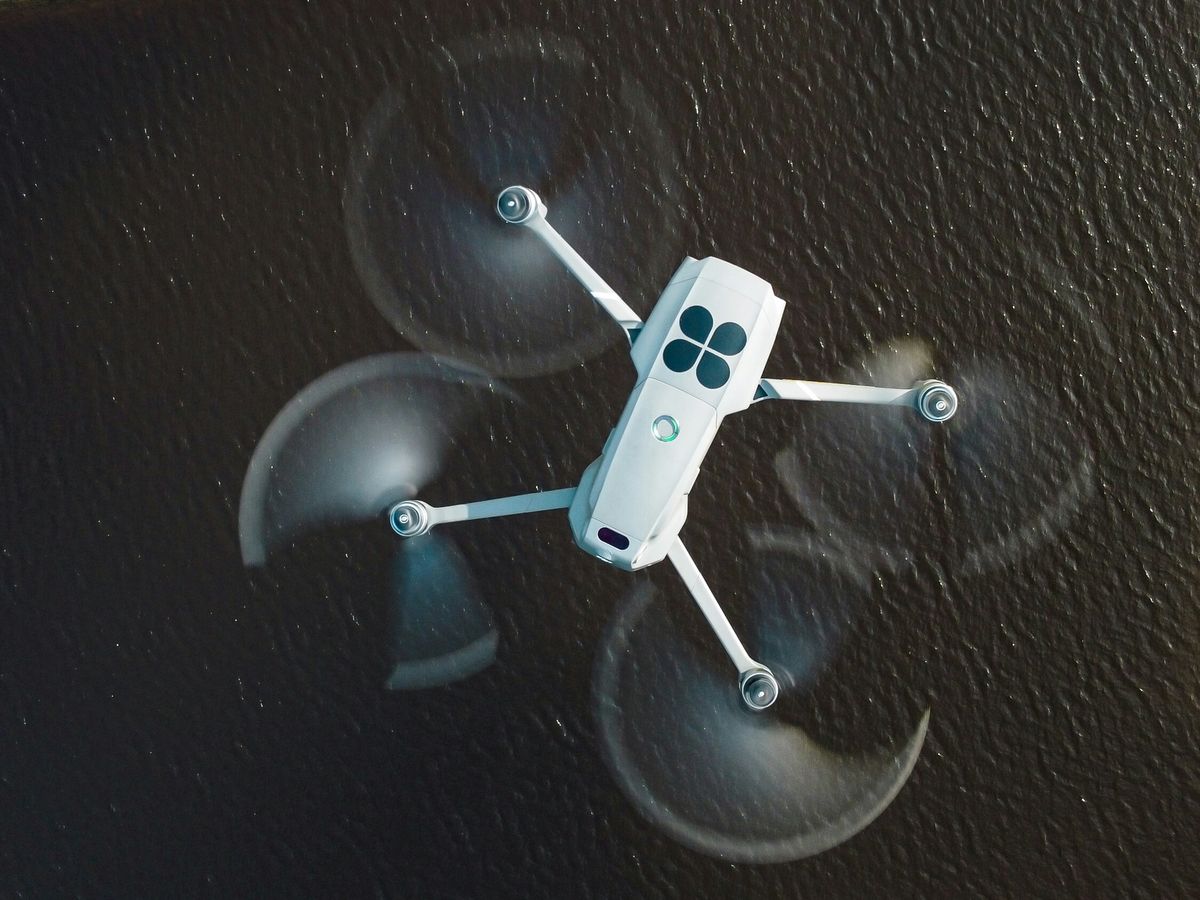
The embedded software, often in C and C++ on microcontrollers, sits alongside the ground station software and, more and more, perception and avoidance functions. Each must be verified according to its role.
Regulations (EU) 2019/945 and 2019/947 classify drone operations according to their risk.
Drones under 25 kg, within the remote pilot's line of sight, up to 120 m. No prior authorisation, never any certification; recent drones bear a class mark.
Beyond visual line of sight, above 120 m, in urban areas with a heavier drone… The national authority authorises the operation, based on a risk assessment, the SORA, or on a standard scenario. The SORA assigns a specific assurance and integrity level, the SAIL, from I to VI.
When the risk requires it, for instance for the transport of people, the drone is certified, like a manned aircraft.
The requirement on the software follows the risk level of the operation.
| Operation | Software reference |
|---|---|
| Open category | No requirement specific to software development: requirements on the product, according to its class mark. |
| Specific, low SAIL | ASTM F3201 describes good practice for the dependability of drone software: development organisation, architecture, code metrics and analysis, code review, quality assurance and testing. It targets in particular the specific category up to SAIL III, and some authorities are considering it as a means of compliance. |
| Specific, SAIL V and VI | The design is verified by EASA. Its means of compliance recognises DO-178C: level B for catastrophic failures, C for hazardous ones, D for major ones. |
| Certified category | A type certification close to that of manned aviation, where DO-178C is the reference for software. |
With DO-178C, structural coverage is required at 100%: statement coverage at level C, plus decision coverage at level B. See the code coverage and standards guide. For defence drones, see also the Aerospace and Defense sector.
Show that the tests, including on the bench and in simulation, have executed the contingency procedures and error branches. See the code coverage and coverage levels guides.
MISRA C and MISRA C++, detection of run-time errors, code metrics and complexity, which ASTM F3201 emphasises. See the MISRA and static analysis guides.
Command link, updates, open-source components: the SORA now has an extension dedicated to cybersecurity. See IEC 62443 and Software composition and CRA.
Gathering, version after version, the verification results required by the authorisation or certification file.
Testwell CTC++ measures the coverage of C and C++ code, from statement coverage to MC/DC, on the host, in simulation or on the flight computer, with the project's cross-compiler and without changing the tests.
TiCS brings together in the same dashboard the results of the analyzers on the embedded code and on the ground station code: coding rules, vulnerabilities, complexity, coverage. Its quality gates keep a regression out of the version that flies.
A free trial of Testwell CTC++ on your own C or C++ code, on the host or on the embedded target.
DO-178C · Code coverage and standards · Code coverage · MISRA · Aerospace and Defense · Sectors
Sources: Delegated Regulation (EU) 2019/945 and Implementing Regulation (EU) 2019/947; JARUS, SORA 2.5 and its cybersecurity extension (2024); ASTM F3201-24; EASA, means of compliance MOC Light-UAS.2510-01, SAIL V and VI ↗; RTCA DO-178C / EUROCAE ED-12C.
Photos: Charlie Mitchell (Unsplash).